
Juraszek Zsuzsi
Normal people do not start leading a company
- In terms of operations, which companies can Maladype be grouped into?
- With those that actually exist as a company like Maladype, they operate as a permanent theater and can provide their actors regular payment and continuous professional development.
- As an independent theater you have been categorized within the meaning of the Performing Arts Act, VI., because you are an independent theater that has been in operation for more than two years and cannot be categorized in the other five categories. How much public support did you receive compared to the rest of the category?
- Unfortunately, it is not clear within the theatrical sphere exactly what conditions an independent theatrical operation with a permanent company must meet. It is no coincidence that there are nearly 150 registered organizations in Category VI, but no one knows what they really are and who they are. No one can list 150 registered and truly operating companies because there are none! A total of approx. there are ten theaters that are active thematically, systematically, developing and maintaining their own repertoire and providing regular monthly salaries to their members. As a registered organization, we were heavily supported with 28 million last year, and only 22 million this year, 36% of which have been blocked forever.
- Why did Maladype get less money this year?
- Good question! I can't explain it - unless there is a personal dislike in the background - because with our operation so far we have not only fulfilled what we described and undertook in our previous year's tender, but also proved it. We have our own performing venue, the Maladype Base (Mikszáth tér 2.), we have become regular guests at international festivals, we have premiered two new performances (Platonov, The marriage of Figaro) and we have established the Free Academy. We have been in a very difficult position with the reduction in subsidies, and I believe that those who have not carried out the selection between companies in good time and to a large extent can do a great deal; the board of trustees, which could not or did not dare to make a responsible decision, which did not undertake to place a maximum of ten independent companies in a prominent position on the theater palette. It seems that what matters to decision-makers is who has what in the past, how much scope they have professionally at home and abroad, and what concrete and viable plans they have for the future. I also consider the ten years behind us to be a great achievement because, in this inability to regulate, Maladype has not only been able to survive but even develop.
- How can you bring your current standards and keep improving when you live day by day?
- Our theater has two strong pillars, actors and spectators. Their relationship drives our performances. Spectators who watch our performances not only at home but also abroad, and possibly attend the Free Academy, will soon get in close and personal contact with us. It is a kind of unspoken contract between Maladype artists and the citizens of society. Due to this, our responsibility to each other is also increasing. We try to move forward and evolve year after year so that the spectator can accompany us on this journey as well. Thus, the common language "grows old" with us. However, this language cannot be created afterwards, but can only be created there, together, minute by minute.
- Based on what has been said, it can be assumed that a theater, which, thanks to secure subsidies, is guaranteed to keep it running, does not seek to keep in touch with the audience. Is that really so?
- Yes, because it’s not in their interest to get in closer contact with their audience. It is a tiring and time consuming process. The relationship between actors and spectators can be significantly changed if we are patient, consistent, and demanding of each other. In recent decades, thanks to Hungarian theatrical conventions, the spectator has accepted that he can only be an “observer” of a performance and in the dark, he can discreetly watch the actor on the stage. It is due to this (also) that the theater has become an aquarium over time. The auditorium can explode, and the actor continues to play the same as if nothing had happened. That’s why I think it’s important that the presence of the spectator influences the actors and impinges on them. Of course, this should be also true the other way around.
- With a little exaggeration, can spectators be divided into two groups: those who take on the role of passive observer and those who want to become part of the creative process?
- With great exaggeration... We were also approached by spectators who had never seen a Maladype performance before and did not know what kind of Leonce and Lena they would see, but when they overcame the shock of the first ten minutes, they became a devoted, enthusiastic audience. Today, these spectators make up a significant portion of our core audience. There is no recipe for this.
- Where do you get the strength and inspiration to invent and pass it on as well new things to inspire others?
- From the world around me, my co-creators and myself. The changes that inspire me the most are prompting me to redefine everything I already think I know. I want others to do the same. I want to make clearer and bolder ‘offers’ to my partners so that we can put together a theater that we all want.
- What do you mean by that?
- I would like actors and spectators to use more precise concepts and more appropriate words when describing a shared experience. I want them not only to be able to talk about their feelings, impressions and opinions in a general and timid way, but also to be able to interpret, analyze and evaluate what they have seen, the events they have lived together.
- As a charismatic leader, you demand constant attention and improvement at all times and a constant 100% presence. How long can the actors withstand this pace and load? Aren't they in danger of burning out?
- I would consider it a dangerous thing not to work with people and artists who see constant concentration and constant redefinition as their personal beliefs and inner need. If the nervous system gets tired, it is followed by physical accidents. In Maladype, every performance from Leonce to Egg(s)Hell is very dangerous. In addition to 100% energy investment and work pace, we also need to use relaxation techniques. If the internal balance tilts a little, a huge accident can occur. The most important thing is not to be willers and not wanting to prove. We enjoy what we do and want to pass on the joy of thinking together and playing together.
- You have regular processing conversations within the company. You have to imagine this by dealing with everyone individually, you ask how they experienced that particular performance?
- Exactly. It is extremely important that we have to be aware of our own “temptations” and dare to act against them. We also encourage our spectators to do so at our performances, audience meetings and at the Free Academy. All of this is part of the inaugural theater program that began with the open rehearsals of King Ubu two years ago. We were the first in Hungary to create a performance by doing a rehearsal process with the audience from the reading rehearsal to the presentation. Of course, all this could only be done if the actors were prepared, enterprising, used their creative energy, did not spasm and the audience was also a good partner for the basic idea. I know that other theaters have since tried this method.
- In Maladype performances, you often encourage the audience to actively participate.
- This is not an alien phenomenon. Ancient Greek theaters were built so that the backs of the spectators could touch the knees behind them. Thus, the spread of the resonance of the stimulus from laughter or crying was felt by everyone. Why not apply it too? The problem with “peephole” theaters is that this deeper and more direct connection cannot be established between the spectator and the actor. The spectator longs for sensual game, not just cultural experience, spiritual excitement. If I, as a practicing theater director, can’t articulate these thoughts and discoveries to myself, then I have no right to ask anything from the actor. And if the actor can’t even articulate himself, he has no right to expect anything from the spectator either. Conversely, if the spectator can’t articulate why he liked or didn’t like a performance or a solution, he can’t hold the artist accountable for anything.
- Thinking and knowledge is a huge and irreplaceable tool on the part of both actors and spectators.
- That's right. If someone doesn’t think, we can do whatever we want with him - we’re not dangerous. On the other hand, if you think about it, you might ask about certain connections that are unpleasant for us and we have to answer - it’s dangerous.
- Can you feel its consequences in the case of financial support of independent theaters?
- Of course. Independence is dangerous because it cannot be grasped and limited, it has an opinion, it is independent and reflexive, it cannot be inserted anywhere.
Founded in 2002, the Maladype Theatre operates with a permanent company and co-creators. Maladype is an independent theater that sustains itself solely from tender funds. However, its “independence” is not only the essence of its organizational form, but also of its spirituality and ideas about theater. It is characterized by a special theatrical language and way of thinking. It relies mainly on concentrated workshop work, intense acting and continuous communication with the audience. Zoltán Balázs, director and artistic director leads the theater, of which eight permanent actors are members. They play 15-17 times a month.
Orsolya Szabó, Műhely, 2011
Translation by Zsuzsanna Juraszek
They didn’t chew the putty
- Zoltán Balázs, the founder, director and director of the Maladype Theatre in Budapest, who "opened" The Kitchen, Arnold Wesker's piece completed in 1959 at the end of last week with the young team of the Andrej Bagar Theater in Nitra, has been preparing for this work for a long time.
- A few years ago, a great project was born based on the idea of Darina Kárová. Six Central and Eastern European directors were given the opportunity to show something in twenty-five minutes. This had such a reception that Darina asked me to direct the Egg(s)Hell in Nitra. Since they couldn’t finance it later, we performed it at home and we’ve already played the fiftieth performance. However, we didn’t discard the possibility of working together. Ján Greššo, the director of the theater in Nitra, watched several of our performances in Budapest, and seeing the Egg(s)Hell, he said he wanted something like that. I already knew then: that’s not possible, because to do that, actors have to know a lot of things beforehand. A performance like that requires a special language, and even three years wouldn’t be enough for that, not to talk about two months. But I promised that if my time allowed, because my life is very busy, I would come up with something that could offer a very strong teamwork with the actors here.
- And so the choice fell on the piece entitled The Kitchen written by a world-renowned London based author of Hungarian origin on the maternal side.
"This piece has been exciting me for a long time," says Zoltán Balázs. - I did not understand why this is a great success from Amsterdam to Madrid, from Helsinki to Athens, from Paris to Rio de Janeiro, because the situation itself, the plot of the piece is actually very simple. There is a kitchen in a large restaurant where people, chefs and waiters cook and whine together. We can't talk about the development of characters with dramatic weight, the situations are two or three sentences, yet the piece itself puts the company, the actors' nervous system, mental condition and physical abilities to the test. Since now I had two months when I could leave my company safe at home, as Sándor Zsótér directed The marriage of Figaro with them, I said I would undertake. But it has been under planning for two years. Meanwhile, we starred here with the Egg(s)Hell, we had great success, which led the director to that belief that a co-production should be created. However, Fico’s party was not very happy that the Hungarians were about to come last year, so the plan was blown away. But because the theater in Nitra was very adamant that at least the staff would come, I said, until Figaro is born at home, I will work here with my people. Last year I worked in France, then in Timisoara, now here in Nitra, and next year I'm going to Switzerland, but Maladype is always in the first place. However, I also need new impulses, new encounters to make a check-up on my own operation.
- The result of a two-month rehearsing process is The Kitchen in Nitra, and although it will shine like a gem on the theatre's repertoire, Zoltán Balázs knows that there is still something to polish.
- We only had one rehearsal a day, as the actors play here every night, but they were very adorable, because we worked a little extra during stolen times in the afternoons. Being an energetic, strong person, I really enjoyed working with this talented team. With the help of Sylvia Huszár, who was my colleague, my interpreter in staging the work, I learned a lot in Slovak, and my dynamism and energy permeated even the safest actor. We didn’t sit at the table for two weeks for analysis, we didn’t chew the putty, we took action right away. Try it, do it, grab it! There was no time to whine, to philosophize, in this system the actor does not have to think about it, here it is necessary to move, to do it, to absorb the situation with its physique and presence, and to put energy into it easily and unnoticed. Seventeen actors play head-to-head, which is certainly strange to the audience here. They are not used to parallel actions, only to single-line things. Seventeen people work here at once and they are lavish in what they offer choreographically.
- "The theater has made a big sacrifice for this performance," says the thirty-three-year-old director. He had to break many rules that were his own. The community cannot do more for a performance, an artistic work than to give up itself and adopt a new style with maximum force, says Zoltán Balázs.
- The actors who play in The Kitchen have come a long way, they haven’t even gotten to where we’re heading together, but they’re already heading in the right direction. Although our joint work ended with the premiere, we are actually starting now. I leave happily, because the company has done a tremendous job, the actors are juggling, braving, but which I am also proud of: they have not betrayed me, they have stood by me all the way, and I know that the performance has a perspective. And not only did they learn, I also gained a lot of experience with them, which I can now turn back into the “common”: to Maladype.
László G. Szabó, Új Szó, 2011
Translation by: Zsuzsanna Juraszek
Risk-free theatre doesn't satisfy me
- They performed in REÖK in Szeged many times - always in front of a crowded house, and you have already “gone through” an audience meeting. What is the audience like in Szeged? Is it open or is it “needs to be educated”?
- There is no problem with the audience in Szeged, they are extremely open, their attention is amazing - I experienced this not only during the performances, but also at the audience meetings. Many people have appeared at our performances in Pest since then, which is a very good thing, as they continue to watch our destiny. We are happy with this series, which was launched by REÖK, as this way we can show a lot of colors from our operation and the series also offers a larger offer to the spectators: if someone has missed out Ubu, for example, they can come and watch Figaro. Sooner or later, everyone meets us, and we meet the audience.
- Anyway, what do you think about educating the audience? Which is usually quite important for companies like yours...
- I believe in it, although the syllable of education bothers me, because unfortunately it is pejorative. I'd rather call it “starting a dialogue”. We recently started the Free Academy, and last year we held open rehearsals for King Ubu for two months. It turned out that spectators didn’t want to be educated, but want actors and creators to open up things that preoccupy them, but don’t get to the point of being uttered or asked out loud. We don’t necessarily wait with this for the end of the performance: actors often strike at changing events during the performance. The dialogue between spectator and creator is important, I don’t believe that the spectators are silly or pliable. We want to provide a forum for dialogue, not only in audience meetings, but also in schools, through open rehearsals, through the blog on our website. They can even come to our Base in Mikszáth Square at any time. You can communicate with us quite spontaneously. We want you to really feel like you are personal acquaintances of our theater. The Free Academy, for example, is suitable for discussing unclear concepts. We dissect a given topic twice a month - with exercises, games, invited guests, spectators. I believe the spectator wants to learn, is curious, and has the right to know and ask things.
- On what concept do you choose the literary materials of your performances? Why did your season start with Platonov which has just premiered and The marriage of Figaro, which is still in the making but soon will also be shown in REÖK?
- On one hand, it is impossible to ignore the personalities that make our theater. I start from them as a director and as a company leader. I know their weaknesses, strengths, manners, and abilities that can and need to be developed. It’s important for me to be able to keep in mind the path I’ve designated for myself. Sometimes I work with very unexpected materials that are not played at home - Hölderlin, Genet, Ionesco, Weöres. At the same time, the company has also moved towards the classical formalists: Büchner, Chekhov, and we will probably have a Shakespeare performance too. The Figaro was chosen by the director, Sándor Zsótér. Stanislavsky once said that it is extremely difficult, yet impossible to direct. Probably it inspired Sanyi so much that he went with it. It is directed under very special circumstances, as on one hand the performance will be shown in our Base - which is practically a large apartment - and on the other hand Mari Törőcsik also got a role in it. Later, during the season, in our upcoming performance entitled Inferno, under my direction the audience will even be able to see one of our actor-icons, Ilona Béres. Platonov was an easy choice for me. An important question in the operation of a company is whether there is a concept, whether there is a plan, whether one can influence the environment, make offers to the participants individually and whether they are able to pass it on. The plan, the design were the things that excited me: I wanted to make a Chekhov that isn’t based on psychologizing analysis and hyperrealistic “muttering”. Platonov was Chekhov's rawest, most elaborate piece, written at the age of just nineteen. There are already many Chekhov motifs in it, but it is so instinctive, raw and cheeky that a young team tries to fill it with strength, dynamics, anger, attention and intellect. An inordinate, free and dense material.
- How does an icon working with such classic acting tools as Mari Törőcsik or Ilona Béres come to you?
- It was my idea and Sanyi's. I almost worked with Mari in the National Theatre, she would have played a male role in The Duchess of Malfi, but she had to be hospitalized then. So this is my debt towards her: now, indirectly, through the company, we can still work together. By the way, this qualifies Törőcsik and Béres much more: they are in such a condition that they still want something unexpected, unusual to happen to them. It is a great recognition that they vote trust for our ensemble.
- Maladype has been around for a long time, yet it's been like you've been picked up lately. From the inside, is this the best era of Maladype?
- Many people say that, but we don't feel that way. When Maladype started, we received insane press coverage, and our performances were called the feast of Hungarian theater. Then, after The Blacks premiered, a few backed away because they couldn’t follow. Now, I am not thinking primarily of the audience, but of the profession. Many were frightened that they needed more attention than they “liked / disliked”. After a while, certain writers and analysts — although the analysis was just missing from their work — glued to us the formalist adjective. At that time, strangely, several branches of professional attention emerged, but Maladype was in constant operation and always in a fairly frequented position. There was a time when some - out of social reasons: few started a family, I couldn’t give them enough money - left the band. Then there was the fact that we were trying to follow an increasingly bolder, but increasingly one-of-a-kind philosophy, where certain acting habits were automatically filtered through the sieve, but that was also normal. Then came Leonce and Lena, which counts as a part of another new era. I just had an unfortunate horse-riding accident, I was lying at home for three months after the surgery, and I was thinking: I wanted to make Leonce and Lena a company piece that brings together the members who just graduated from college at the time, but I didn’t want us to do our own “a hundred after another” Leonce-reading. I wanted the actors to come up with variations, thoughts, spontaneous ideas. So that’s how it came to be that each scene was made in four variations. Theater is usually risk-free, everyone knows exactly what they are doing, finds the props, and so on. I felt it didn’t satisfy me, and then, thank God, with a new impetus, we offered ourselves a new opportunity. We later built Egg(s)Hell, Ubu and Lorenzaccio on this. This conscious change, of course, required partners. I am a happy person and director because on the one hand I have never had to compromise and on the other hand I have found friends in the actors and direct staff who are partners in change, in constant experimentation. They understand, represent and work to a high standard for it. It is independent from whether or not we are recognized, but the fact is that we have a strong audience, and we are also receiving professional attention at home and abroad.
- You maintain your actors strongly both physically and mentally. I recently attended a university lecture by Sándor Zsótér, where he was asked what makes a good actor. He replied that he was open minded, curious, and so on. A couple of actors and companies came to my mind based on his response, and Maladype was among the first. What acting qualities do you expect from them?
- Sanyi preceded me with the answer. It’s no coincidence that Lorenzaccio did so well: his personal world, his ironic, scratchy humor, his intellect rarely meets an entire band. It happens more with one actor - now, for example, with Éva Kerekes in Örkény. So I agree with Sanyi. In addition to being open, an actor must be demanding of himself, his partners, and the material. You should not be afraid of change, and you should be specifically excited about the possibility of change. Abroad, they always think our actors are acrobats or dancers. Of course, this is not the case: they are prose actors who are good with their bodies. Basically, it all depends on the mental condition, how attention, intellect and thoughts can be organized in the brain. The actor doesn’t have to be a groping creature of instinct in the dark who then either feels something or not. Using his instincts well, yet interpreting his own situation in the given piece and company, he has to come up with newer and newer suggestions for himself and his environment.
- Small, alternative, companies working with strong workshops and work ethic based on thinking together like you run the risk of burning out in the process of thinking together leading to explode what has worked well so far. Like Krétakör. Do you see a chance for this in the - hopefully distant - future of Maladype?
- The danger was in our seventh year around my accident. However, we’ve embarked on another seven-year series: we’re in our third year now, we have four more, I hope. Since the company is ten years old next year, I’d rather count on another ten from next year, and I’ll be very happy to have twenty years once. Although Ariane Mnouchkin - who is now celebrating the 40th anniversary of the Sun Theater - says she herself doesn’t believe they could spend that much time together, and there were so many opportunities and problems during that time that the company could have disintegrated every day. There are good and bad examples. I feel the team will still stay together for the next four years, moving forward very cleanly and consciously. Especially - and this is the most important - if you have such strong and good playmates as the Szeged audience.
Barbara Fábián, Páholy, 2011
Translation by Zsuzsanna Juraszek
Zoltán Balázs' Sarajevo production won the Golden Mask Award!
In Bosnia-Herzegovina, at the 63rd MESS International Theater Festival, representatives of the press and critics awarded Zoltán Balázs' Sarajevo production with the Golden Mask Award. An important role in the justification of the recognition was played by the timeless power of Susan Sontag's post-dramatic text, Zoltán Balázs's unique and special directorial vision and his theatrical handwriting reminiscent of Ionesco's engravings, as well as the high-level artistic performance of the SARTR Theater ensemble's new approach to stage reality.
ZOLTÁN BALÁZS' DIRECTION OPENS THE 63RD MESS FESTIVAL IN SARAJEVO!
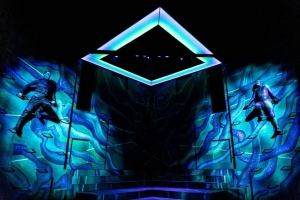
Frankenstein
Translated by: Gábor Koltai M.
Director: Zoltán Balázs

Frankenstein's "modern Prometheus" story is an apocalyptic formulation of loneliness and exclusion. A creation myth that explores the fears of the people of our time with ruthless honesty. The cult work created in 1818, on the Gothic, or "night of the ghost", is the eerie imprint of Mary Shelley's imagination, who was only 19 years old at the time, in which an "ungodly" science student, Victor Frankenstein, brings to life the creature without "original sin", the A creature. For Victor, the sight of Creation made of "human debris" is horrifying, so he pushes it away. The superhumanly strong Being is cold and afraid, he does not understand the world around him. At first he becomes a silent character in the life of a family, but he reveals himself and is forced to flee. Tragic adventures and humiliating encounters accompany his journey, and he also commits a murder. With the help of a notebook found in Victor's cloak, he visits his creator to giggle for his love and support. Frankenstein promises to create a female creature for him to share his loneliness, but later reneges on his promise. The Creature takes revenge and the demonic chase between the creator and the created begins...
The original Frankenstein has been adapted into hundreds of literary, film and theater adaptations, retelling the story of the horror novel's crazy, vengeful and bloodthirsty characters in the most varied forms. Nick Dear's innovative and highly successful adaptation of Frankenstein examines the Creature's both formless and enchanting nature in the light of a distorted world order. The psychologically precisely structured drama is based on phase studies of psychological processes and places them in a moral and social context.
The adaptation presented on the 11th of March in 2023, directed by Zoltán Balázs, known for his unique theatrical visions, boldly mixes abstract, stylized, raw and natural elements. He speaks frankly about man's greatest enemy: the dark power accumulated within him. It evokes our anxieties, fear of death and sexuality. The performance, which combines special visual and acoustic solutions, explores the possibilities of forgiveness and common sense amid the coordinates of a deranged evolutionary experiment that radically breaks the symmetry of a degenerative world and society. The stage production, which examines the antecedents of the Creature's anti-civilization behavior and the driving forces behind its rebellious behavior, reveals the eternal fall of the soul shrunken after disappointment...
Cast:
Victor Frankenstein: Tamás Gulácsi
The Creature: Attila Gulyás
The Female Creature: Zita Széles
Monsieur Frankenstein, Victor's father / William Frankenstein, Victor's younger brother / De Lacey, blind old man: Attila László Horváth
Elisabeth Lavenza, Victor's fiancee: Petra Ténai
Clarice, the housekeeper of the Frankenstein family: Réka Horváth
Felix, son of De Lacey / Violent / Gustav, beggar / Prisoner, farmer / A policeman: Zoltán Rák
Agatha, daughter-in-law of De Lacey / Gretel, prostitute / Hanne, beggar / Molly, farmer: Noémi Fridrik
Creators:
Director: Zoltán Balázs
Dramaturg: Nóra Sediánszky
Set designer: Éva Szendrényi
Costume designer: Anikó Németh
Help: Erzsébet Nagy
Supervisor: Csaba T-laforest
Director assistant: Anna Demeter
Opening Night: 11.03. 2023. Móricz Zsigmond, Main Stage, Nyíregyháza
Duration of the performance: 120 minutes